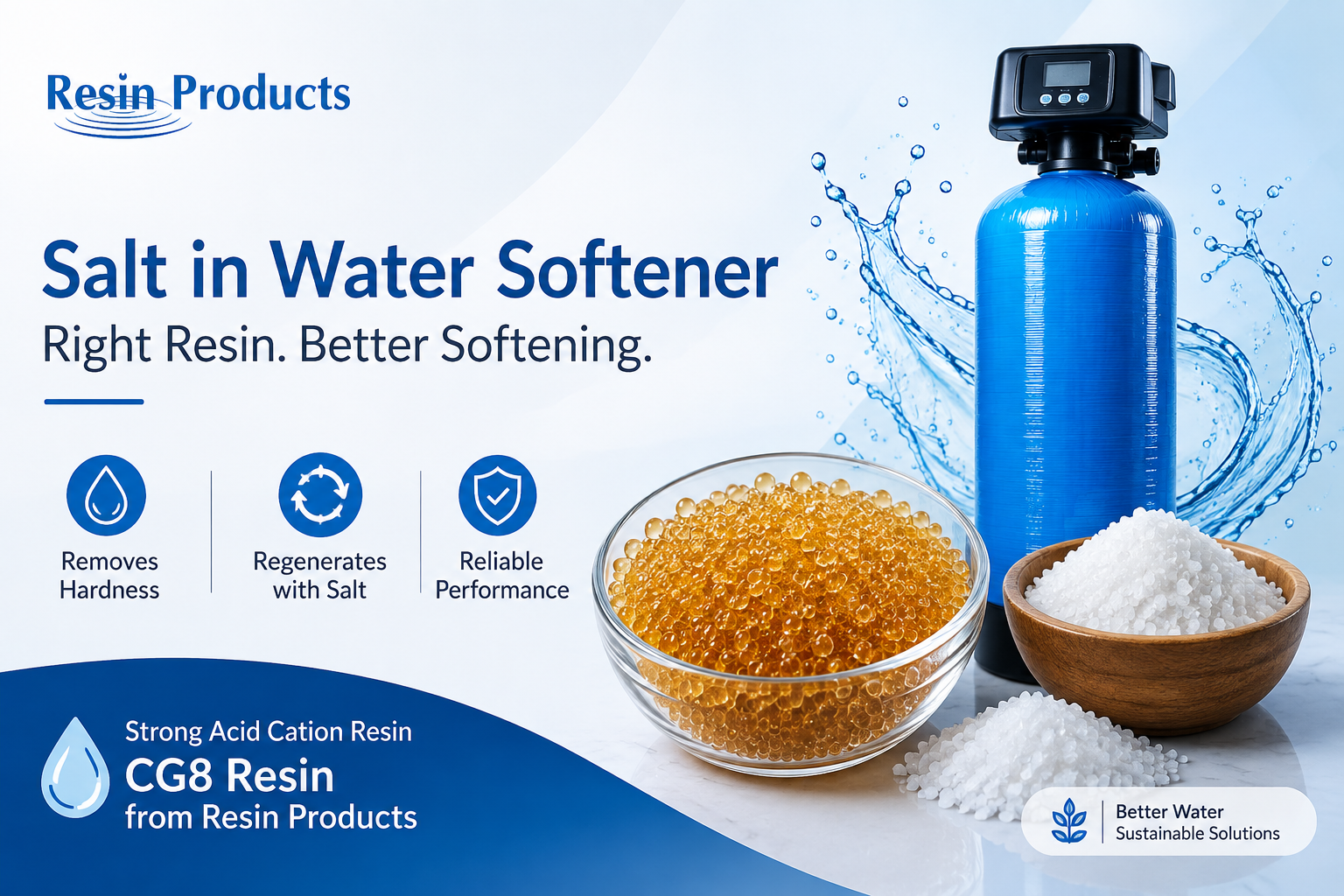
Salt in Water Softener: How It Works and Which Resin to Use
Hard water contains high levels of calcium and magnesium ions. These minerals can create scale inside pipes, boilers, heaters, and appliances. Therefore, water softeners help reduce hardness before water enters the distribution system.
Most traditional water softeners use salt and ion exchange resin . The salt regenerates the resin after it captures hardness minerals. As a result, the resin can continue softening water through repeated service cycles.
For industrial applications, choosing the correct ion exchange resin material remains important. The right resin improves softening performance and supports reliable water treatment.
What Does Salt Do in a Water Softener?
Salt does not directly remove hardness from water. Instead, it regenerates the ion exchange resin inside the softener.
During normal operation, hard water passes through the resin bed. Calcium and magnesium ions attach to the resin. Meanwhile, sodium ions remain available for exchange.
Over time, the resin becomes loaded with hardness ions. Its softening capacity then decreases.
During regeneration, a concentrated salt solution passes through the resin. The sodium ions replace the calcium and magnesium ions. The resin then returns to its sodium form.
Therefore, salt plays an essential role in maintaining resin performance.
How Does Ion Exchange Resin Soften Water?
Ion exchange resin material contains millions of small exchange sites. These sites attract positively charged ions from water.
Strong acid cation resins are widely used in conventional water softeners. They exchange hardness ions with sodium ions during the softening process.
The basic process works as follows:
- Hard water enters the softener vessel.
- Calcium and magnesium contact the resin.
- The resin captures these hardness ions.
- Sodium ions move into the treated water.
- The water leaves the vessel softened.
- Salt regeneration restores the resin capacity.
Consequently, the system can provide consistent softened water when operated correctly.
Strong Acid Cation Resin for Water Softening
Strong acid cation resins are a popular choice for water softening applications. They work effectively across a broad pH range.
These resins typically contain sulfonic acid functional groups. Therefore, they can exchange calcium and magnesium ions efficiently.
Resin selection should consider several factors. These include water chemistry, hardness level, flow rate, operating temperature, and regeneration conditions.
For commercial and industrial systems, resin quality also affects service life and operating efficiency.
CG8 Resin from Resin Products for Water Softening
For water softening applications, CG8 Resin from Resin Products can be considered as an ion exchange resin solution.
CG8 is a strong acid cation resin designed for ion exchange applications. It can be used in water treatment systems where hardness removal is required.
The resin works by exchanging hardness ions with sodium ions. During regeneration, the resin receives sodium ions from the salt solution.
Therefore, CG8 Resin can support conventional sodium-cycle water softening systems.
Industrial Water Treatment Applications
Industrial water treatment requires consistent control over water hardness. Hardness can cause serious scaling problems in many systems.
Water softening systems are commonly used before boilers, cooling systems, and process equipment. They can also support commercial water treatment installations.
Using suitable ion exchange resin material helps maintain stable treatment performance.
However, operators should select resin according to the specific feed-water conditions. Resin capacity and regeneration requirements can vary between applications.
Therefore, proper system sizing remains as important as resin selection.
Why Choose Resin Products for Ion Exchange Resin?
Resin Products supplies ion exchange resin solutions for different water treatment requirements.
The company offers products for applications involving water softening, demineralisation, purification, and other treatment processes.
For water softening systems, selecting a suitable strong acid cation resin can improve hardness removal. Additionally, the correct resin can help maintain predictable regeneration cycles.
Before selecting a resin, customers should review their water analysis and operating conditions. This approach helps identify the most suitable resin grade for the application.
How Much Salt Does a Water Softener Need?
Salt consumption depends on resin volume, water hardness, system capacity, and regeneration settings.
A larger resin bed generally requires more salt during regeneration. Similarly, higher water hardness can increase the regeneration frequency.
Therefore, there is no single salt quantity for every softener.
Modern systems can reduce salt consumption through efficient regeneration settings. Regular monitoring can also prevent unnecessary regeneration cycles.
Salt vs. Resin: What Is the Difference?
Salt and resin perform different functions in a softening system.
The resin removes hardness ions through ion exchange. Meanwhile, salt regenerates the resin after its exchange capacity decreases.
Therefore, both components support the overall softening process.
Without suitable resin, salt cannot soften water effectively. Likewise, without proper regeneration, the resin eventually loses its softening capacity.
Frequently Asked Questions
1. Does salt remove calcium from hard water?
Salt itself does not remove calcium directly. Instead, salt regenerates the ion exchange resin that captures calcium and magnesium.
2. Which resin is best for water softening?
Strong acid cation resin is commonly used for sodium-cycle water softening. The appropriate grade depends on water chemistry and system conditions.
3. Can CG8 Resin be used in water softeners?
Yes, CG8 Resin from Resin Products can be used for suitable water softening applications. Always confirm compatibility with your feed-water conditions.
4. How often should water softener resin regenerate?
Regeneration frequency depends on water hardness, water consumption, resin volume, and operating capacity. Proper system settings help optimise regeneration.
5. How long does water softener resin last?
Resin life depends on water quality, operating conditions, regeneration practices, and maintenance. Proper operation can significantly extend resin service life.
Conclusion
Salt and ion exchange resin work together in conventional water softening systems. The resin captures calcium and magnesium from hard water. Meanwhile, salt restores the resin during regeneration.
For industrial and commercial applications, choosing the right strong acid cation resin is essential. CG8 Resin from Resin Products can provide a suitable option for compatible water softening systems.
Before purchasing resin, review your water analysis and system requirements. This ensures better performance, efficient regeneration, and dependable hardness reduction.